

In WordPress hosting, the conversation around growth has gradually changed. It’s no longer only about acquiring new customers directly, but also about supporting the entire network of people who deliver hosting downstream: agencies wanting to serve their clients under their own name, freelancers adding hosting to their service packages, and small teams building miniature hosting businesses without running full infrastructure. This reselling model has become one of the most reliable ways the industry expands, and it’s been clear for a while that PanelAlpha needs to make that path smoother. With version 1.6.0, we’re stepping right into that space.
A new place for resellers to call home
The new release brings white-label reselling directly into the platform as a native part of how PanelAlpha operates. Administrators can now assign reseller permissions to any user, turning a regular customer into a small-scale WordPress hosting provider with a few clicks, while still maintaining full control over the product.
Once enabled, the customer enters their own Reseller Area, where they can:
- build their own brand with white-label customization,
- connect a personal email identity,
- work with a dedicated Reseller API,
- view activity logs for users under their account, and
- manage the entire list of users they onboard.
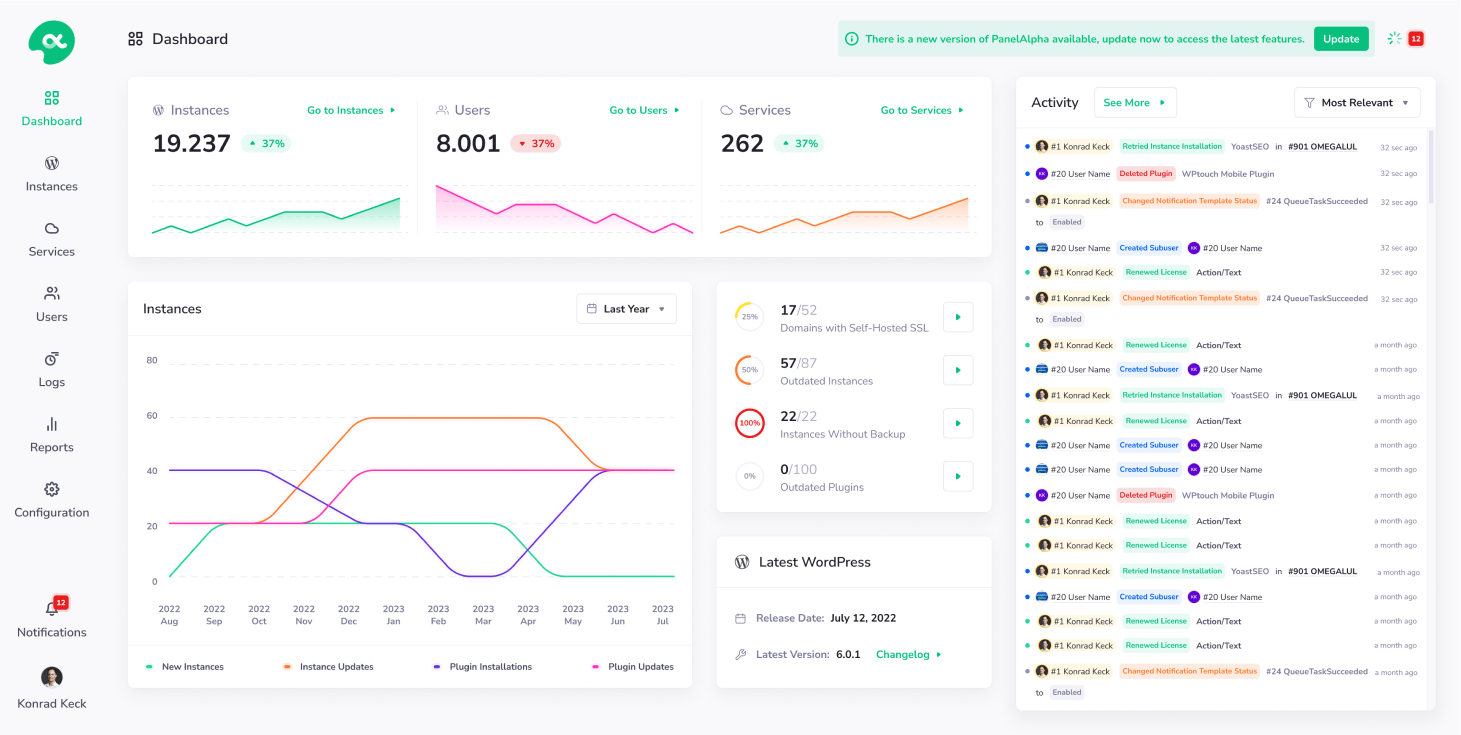
Everything stays inside one familiar interface of PanelAlpha’s client panel:

What does this mean in practice? More earning potential, more independence, and a more inviting experience for everyone. For hosting providers, it creates extra revenue potential without putting pressure on daily operations. For resellers, it’s the difference between offering “hosting as a favor” and running a real service with their own brand and tools. And for end users, it’s simply access to hosting through someone they trust.
It’s a win in every direction, and a feature that matches where the hosting ecosystem is already heading – toward models that let multiple layers of business grow in parallel.
A more reliable SSL experience with Let’s Encrypt
Anyone who has spent any bit of time behind the scenes of WordPress hosting knows that Let’s Encrypt is a blessing, but certificate automation can still get tricky in real-world hosting environments. We heard enough clear examples from our customers to know that the integration needed adjustments that didn’t stop at the surface.
That’s why, in PanelAlpha v1.6.0, the SSL flow has undergone a more comprehensive rework. Instead of addressing symptoms one by one, we looked at the full lifecycle of certificate issuance and renewal, and refined the logic around it. The goal was simple: make sure the sites issue and renew certificates with no odd validation surprises, and far less back-and-forth when they approach expiration. The end result is a smoother Let’s Encrypt experience that reduces support load for providers and removes the anxiety users sometimes feel around SSL.
DNS zones created at the right moment
The same attention to everyday reliability guided the update to how DNS zones are created. Until now, a zone was generated only after the WordPress instance was deployed on the hosting server, which occasionally delayed propagation and forced certain workflows to depended on records that weren’t yet in place.
PanelAlpha v1.6.0 flips that order. Now, the DNS zone is created first, and the instance follows immediately after. This small restyling makes domains ready sooner, speeds up processes that rely on DNS, and lets the whole setup fall into a more intuitive rhythm, something that makes a real difference for teams juggling multiple instances or time-critical projects.
Looking back, looking forward
Releases like this make it hard not to notice how far PanelAlpha has come in just one year. We stepped into 2025 with WithoutDNS integration, delivered 1-Click Trial Sites, enabled upgrade paths straight from the control panel, brought Atarim into the mix, and launched PanelAlpha Engine v1.0. Each of these marked a moment when the platform opened up a little more space for users to work exactly the way they wanted.
And if our roadmap is any hint about 2026, we’re nowhere near done. The queue of upcoming features is full, ambitious, and already taking shape. So keep an eye on what’s next – we’re still exploring just how far automation can take WordPress hosting, and version 1.6.0 is only another step along that path.




Comments